
 By Charles Pemu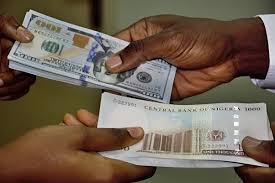
The Nigerian Naira has lost recent stability, weakening sharply at the parallel market as high retail demand for foreign exchange (FX) and the US Federal Reserve’s (Fed) hawkish stance exert significant pressure on the currency.
The Naira depreciated in the Nigerian Foreign Exchange Market (NFEM), where the dollar was quoted at $\text{N}1,454.38/$ on Tuesday, compared to 1,448.43/$ on Monday, according to data from the Central Bank of Nigeria (CBN). This decline continued on the unofficial market, with the Naira weakening further to N1,483/$on Wednesday morning.
Importers and retailers are actively front-loading dollar purchases to prepare for the high volume of Christmas and New Year’s sales, driving up immediate demand for foreign exchange. This retail-level dollar sourcing, particularly boosted by increased international travel reservations and overseas school fee payments, is heavily impacting the parallel market.
Simultaneously, the Fed’s “hawkish” posture signaling that higher interest rates may be maintained for longer than markets anticipate combatting persistent inflation is making the US dollar (USD) more attractive. This dynamic leads to capital outflows from frontier markets like Nigeria as investors chase higher yields in US assets. Traders report that businesses are accelerating their foreign exchange obligations ahead of the year-end, putting mild but continuous stress on the market.
Despite the recent volatility, the Naira still boasts a Year-to-Date appreciation of about $5.7% against the USD, largely thanks to interventions by the CBN, FX reforms, and steady diaspora remittances, which had stabilized the rate in the N1,450–N1,470 / range since early December.
The markets have priced in a high probability (nearly 87.4% percent, down from 85 percent in November) of a 25-basis-point (bp) rate cut at the Fed’s highly anticipated December 9–10, 2025, meeting, which concludes today.4
However, strong resistance from hawkish Fed officials is fueling uncertainty. Key voices, including Kansas City Fed President Jeffrey Schmid, argue against any cuts, citing persistent inflation that remains above the 2 percent target. Other hawkish members warn of stalled inflation progress and advocate for a policy pause. The FOMC minutes indicate that up to five voting members oppose further cuts.
In market reaction, the USD Index (DXY), which measures the dollar’s strength against a basket of six currencies, turned higher after the release of the robust US job report. The US Labor Department’s JOLTS report showed job openings increased to 7.67 million in October, exceeding projections and suggesting a resilient labor market that could influence the Fed to slow its rate-cutting schedule.9 The index is trading flat at 99.20 as traders remain on the sidelines ahead of the crucial Fed decision.
Traders expect Fed Chair Jerome Powell to potentially deliver a “hawkish cut” a rate reduction combined with cautious forward guidance indicating a possible pause in 2026. This would raise the bar for subsequent rate cuts, a shift already reflected in the market where short-term futures now show only a 60 percent chance of a cut, down from 85 percent in November. The previous two Fed cuts this year were intended to counteract deteriorating employment conditions, including an increase in the unemployment rate to almost 4.5 percent.